
What is Meta Ads?
Meta Ads is the advertising platform that powers paid campaigns across Facebook, Instagram, Messenger, and the Audience Network. With Julius connected to your Meta Ads account, you can explore campaign performance data, see what’s working, and make data-driven decisions to improve ROI. Julius gives you natural language access to all your Meta advertising data. Track conversions, analyze engagement metrics, or compare performance across campaign objectives without opening Ads Manager or exporting CSV files.Connecting Julius to Meta Ads
The setup uses Facebook’s secure OAuth system. You log in with your Facebook account and grant Julius permission to access your advertising data.Navigate to Data Connectors
Go to your Julius Data Connectors Settings and select Meta Ads from the list of available options.
Authenticate with Facebook
When you click Connect to Meta Ads, you’ll be redirected to Facebook’s authorization page:
-
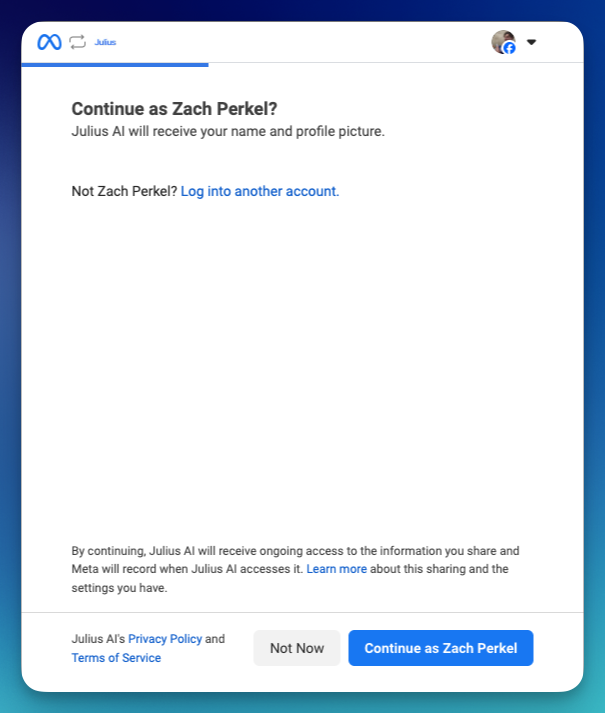
Confirm your Facebook account. You’ll see a screen asking you to continue with your Facebook account. Click Continue to proceed.
-
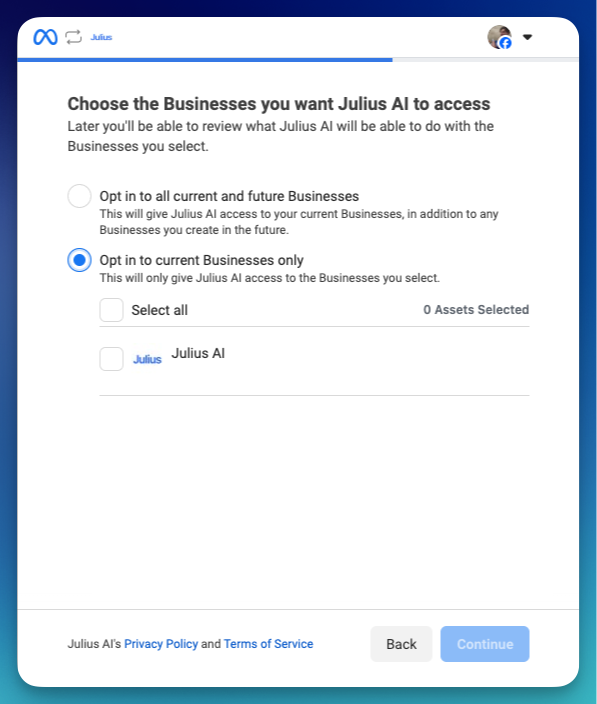
Choose which businesses to grant access to. Select the ad accounts and businesses you want Julius to access. You can opt in to all current and future businesses, or only current ones. Check the boxes next to the businesses you want to connect, then click Continue.
-
Review and approve permissions. Review the permissions Julius is requesting:
- Manage ads for ad accounts that you have access to
- Access your Facebook ads and related stats
- Manage your business
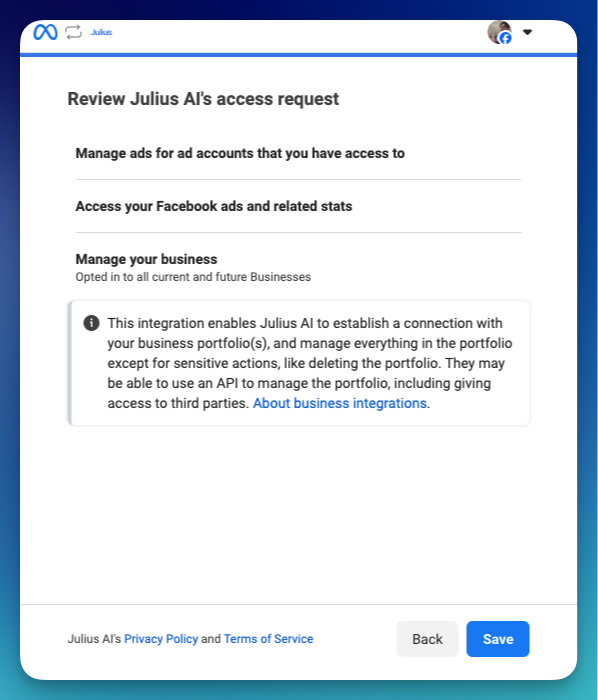
Julius requests permission to read your ads data and access business information. This is a read-only connection — Julius cannot create, modify, or delete your campaigns, ads, or settings through this connector.
Start analyzing
That’s it. Your Meta Ads account is now connected. Start a conversation with Julius and ask questions about your advertising performance.
Using your Meta Ads connector
Once connected, you can explore performance at multiple levels and access detailed metrics about how your ads are performing. You don’t need to know how to structure Meta Ads API queries — just ask questions naturally:Understanding campaign performance
Understanding campaign performance
- “What’s my average cost per result by campaign objective?”
- “Show me campaigns with spend over $1000 this month”
- “Which campaign has the best ROAS in the last 7 days?”
- “Create a chart of impressions vs reach by campaign”
Analyzing ad creative
Analyzing ad creative
- “Show me the top performing ads by click-through rate”
- “Which ad creatives have the lowest cost per conversion?”
- “Compare engagement rates across my different ad formats”
- “What’s the average frequency of my ads?”
Budget and spend analysis
Budget and spend analysis
- “How much did I spend on Facebook vs Instagram last month?”
- “Show me daily spend trends for Q4”
- “Which ad sets are spending the most with the worst performance?”
- “What’s my total spend by campaign objective this year?”
Conversion tracking
Conversion tracking
- “Show me conversions by attribution window”
- “What’s my cost per purchase by ad set?”
- “Compare conversion rates between desktop and mobile”
- “Which campaigns are driving the most add-to-cart events?”
Levels of analysis
Meta Ads data is organized hierarchically (Account → Campaigns → Ad Sets → Ads). Julius can analyze your performance at any level:- Account level — Bird’s-eye view of overall advertising performance across all campaigns. Total spend, overall ROAS, aggregate metrics.
- Campaign level — Compare objectives and strategies. Brand awareness vs conversion campaigns, seasonal promotions.
- Ad Set level — Targeting and placement decisions. Which audiences, demographics, or placements are performing best.
- Ad level — Individual ad performance. Compare creative approaches, headlines, calls-to-action.
Available metrics
Julius has access to the full range of Meta Ads metrics:- Core performance — impressions, reach, frequency, clicks, spend
- Engagement — likes, comments, shares, post engagement; for video ads, view durations, completion rates, and engagement at different timestamps
- Conversion — purchases, signups, app downloads, broken down by attribution window (1-day click, 7-day click, 28-day click, etc.)
- Cost efficiency — CPC, CPM, cost per action
- Video performance — view counts, average watch time, completion rates
Time-based analysis
Simply specify the time period you’re interested in:- “Show me daily spend for the last 30 days”
- “Compare this quarter to last quarter”
- Compare across different date ranges
- Identify trends and seasonality
- Track the impact of budget changes or creative updates
- Analyze day-of-week or hour-of-day patterns
Understanding your Meta Ads data
Account structure and hierarchy
Your Meta Ads data follows a clear hierarchy: Account → Campaigns → Ad Sets → Ads.- Accounts contain all your advertising activity for a business
- Campaigns define your advertising objective (conversions, traffic, brand awareness)
- Ad Sets control targeting, placement, budget, and schedule
- Ads are the actual creative assets people see
Multiple ad accounts
If you manage advertising for multiple businesses or clients, Julius automatically connects to all ad accounts you have access to. Each appears as a separate connection, making it easy to keep analysis organized and avoid mixing data.Best practices
Be specific about time ranges. Meta Ads accounts can contain years of campaign data. Instead of “Show me all my campaigns,” try “Show me active campaigns from the last 30 days” or “Analyze performance for December 2024.” Start broad, then drill down.- First, ask “Which campaigns spent the most last month?”
- Identify a campaign of interest
- Drill down with “Show me the ad sets in [campaign name] by performance”
- Get granular with “What ads in [ad set name] have the highest engagement?”
- “Show me campaigns with declining performance week over week”
- “Which ad sets have high spend but low conversions?”
- “What ads have frequency above 5?”
- “Show me campaigns with ROAS below 2.0”
Questions to get started
Quick performance snapshot:- “Give me a summary of my ad account performance this month”
- “What’s my total spend and ROAS for active campaigns?”
- “Show me my top 10 ads by conversions”
- “Which campaigns have high impressions but low clicks?”
- “Show me ad sets with declining performance over the last 2 weeks”
- “What’s my most expensive campaign in terms of cost per result?”
- “Compare my awareness campaigns vs conversion campaigns”
- “How do my Instagram ads perform compared to Facebook?”
- “Show me engagement rates across different ad formats”
- “Where am I spending the most money with the lowest return?”
- “Which ad sets should I increase budget for based on performance?”
- “Show me daily spend trends to identify budget pacing issues”
Troubleshooting
Can't see my ad accounts during setup
Can't see my ad accounts during setup
Make sure you’re logged into Facebook with the account that has access to the ad accounts you want to analyze. If you manage ads through Business Manager, verify that your Facebook user has the appropriate permissions (like Ad Account Advertiser or Ad Account Analyst) for those accounts.If you’ve recently been granted access to new ad accounts, try disconnecting and reconnecting your Meta Ads integration to trigger a fresh sync.
Connection expired or authentication errors
Connection expired or authentication errors
Meta access tokens automatically refresh, but occasionally you may need to reconnect. Go to your Data Connectors settings, disconnect your Meta Ads connection, and set it up again by going through the OAuth flow.This is safe — reconnecting won’t affect your campaigns or delete any data.
Missing recent campaign data
Missing recent campaign data
Meta Ads data can take a few hours to become available through the API, especially for very recent campaigns. If you’re not seeing data from the last few hours, try querying again later.For most reporting purposes, data from yesterday and earlier should be complete and accurate.
Julius says it can't find a campaign or ad set
Julius says it can't find a campaign or ad set
Verify that the campaign or ad set exists in the ad account you’re querying and is within the date range you specified. Deleted or very old campaigns may not be accessible.If you have multiple ad accounts connected, specify which one by name in your question.
Getting 'permission denied' errors
Getting 'permission denied' errors
This usually means your Facebook user doesn’t have sufficient permissions for certain ad accounts. Check your Business Manager settings to ensure you have at least Analyst-level access to the accounts you’re trying to query.If you’re certain you should have access, try disconnecting and reconnecting.
Security & privacy
Your Meta Ads connection uses OAuth 2.0 authentication.- You’re always in control. You grant Julius permission through Facebook’s official authorization system and can revoke access at any time through your Facebook settings or the Julius Data Connectors page.
- Read-only access. Julius can only view your advertising data. It cannot create campaigns, modify budgets, change targeting, or make any changes to your account.
- Encrypted storage. All access tokens are encrypted using Google Cloud Key Management Service (KMS).
- Automatic token management. Julius refreshes tokens automatically without requiring re-authentication, while keeping them encrypted.
- SOC 2 Type 2 Certified. Julius meets rigorous security standards for handling sensitive business data.
Learn more about security
Visit our Security & Trust Center to learn how Julius protects your data and maintains compliance standards.
Managing your connection
Disconnecting Meta Ads
If you need to disconnect your Meta Ads account from Julius, you can do so at any time from your Data Connectors settings. When you disconnect:- Julius immediately revokes its access to your Meta advertising data
- All stored credentials are securely deleted
- Your ad account connections are removed from Julius
- Your campaigns and data in Meta remain completely untouched
Reach out to team@julius.ai for support or to ask questions not answered in our documentation.